

About
I am a PhD candidate in Political Science at UC Santa Barbara, where I also serve as a teaching assistant. I am affiliated with the EGAPE Lab and the 2035 Initiative. My advisor is Paasha Mahdavi. In 2026-2027, I will be a fellow at the Lemelson Center for the Study of Invention and Innovation at the Smithsonian Institution, where I will conduct archival research on the history of carbon capture in the United States.
I am a comparativist in the fields of political economy and environmental politics who studies how governments and firms navigate the energy transition. Substantively, I research why countries vary in Carbon Dioxide Removal (CDR) policy regimes, how firms respond to shareholder pressure on climate strategy, and what predicts the innovation of clean technologies in the era of polarization. I am a methodological pluralist who uses causal inference, text analysis, and process tracing. In my time as a PhD student I developed text classification models for detecting and categorizing corporate climate disclosure in SEC filings, available on Hugging Face.
My academic journey started with a dual-degree program in Political Science at the Moscow School of Social and Economic Sciences and International Politics at the University of Manchester, UK. I also spent a year as an exchange student at West Virginia University (once a Mountaineer, always a Mountaineer!). Before UCSB, I worked as a Sustainability & Risks Consultant at KPMG, as a Deputy Director at SDSN Russia, and interned at Transparency International.
Research
My research focuses on the political economy of climate innovation and deployment. I study how governments, firms, and regulators navigate the energy transition using quantitative methods.
Dissertation
The Political Economy of Carbon Dioxide Removal Policies in Advanced Democracies
Meeting the IPCC targets will require removing billions of tons of CO2 from the atmosphere, yet current global capacity stands at roughly 50 Mt. Advanced democracies have adopted distinct policy regimes for carbon dioxide removal (CDR). My dissertation asks why the US, Canada, Norway, and Australia vary on three CDR policy dimensions: the policy means governments use to support CDR (tax credits vs. SOE vs. grants), the durability of that support across changing administrations, and which technologies fall within policy scope. Using within-case process tracing with Bayesian probability across four country cases, I argue that past industrial infrastructure (like EOR in the US), interest group intermediation, and state capacity in the crisis co-explain cross-national variation in CDR policy. A theory chapter develops the mechanism behind that variation: carbon capture is unusually fungible, reading as a climate measure, a production subsidy, and a jobs program at once, which lets coalitions recruit it into conflicts already underway and put it in the place of a stick that did not pass.
Committee: Paasha Mahdavi (Chair), Leah Stokes, Matto Mildenberger, Bruce Bimber
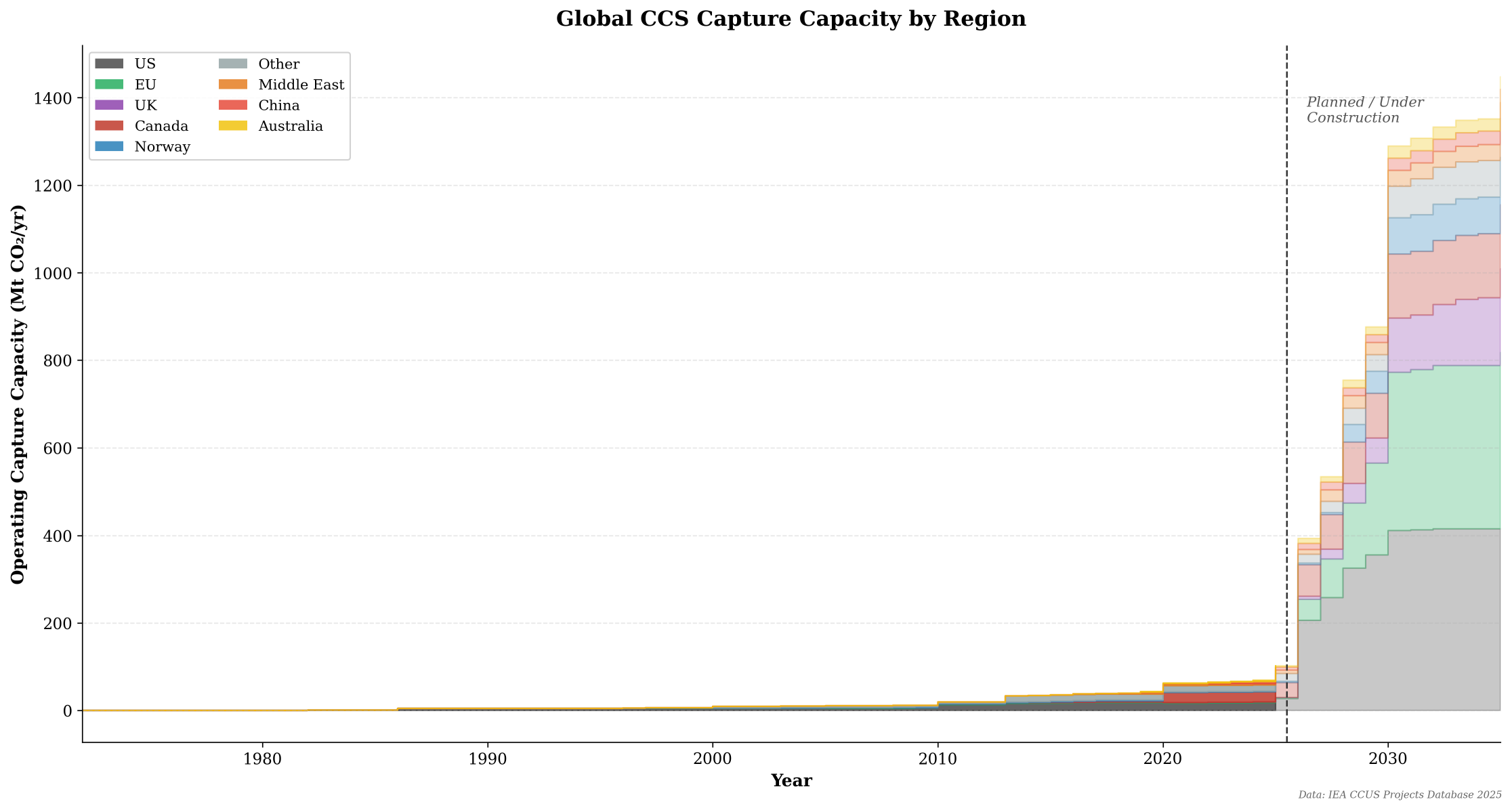
Global CCS capacity by region, 1996-2035 (historical and planned)
Peer-Reviewed Publications
Limited Impacts of Shareholder Pressure on Climate Strategy of Fossil Firms
Transitioning away from fossil fuels is in the best interest for long-term stakeholders of oil firms to mitigate risk from climate policy. Yet firms have an informational and positional advantage over strategies to mitigate climate-related risks, such that there is little incentive to decarbonize. Building on theories of firm behavior and the three faces of political power, we argue that investor pressure will be unlikely to change the climate strategy of fossil fuel firms. To measure climate strategy, we develop a novel technique using natural language processing (NLP) tools to parse annual filings of all publicly-listed oil firms in the US. Using a difference-in-differences design exploiting an exogenous shock to shareholder power from a Securities and Exchange Commission regulatory amendment, we find no effects of shareholder pressure on deep reforms to climate strategies and weak effects on incremental pro-climate behavior. Through a case study of ExxonMobil, we show that climate-motivated investors are unable to overcome internal stakeholder resistance, despite shareholder pressure through direct communication, filed resolutions, and media campaigns. Our findings illustrate that polluting firms remain resistant to financial pressure for decarbonization, suggesting an important role for policy.
The Role of Digitalization in the Global Energy Transition
This article examines the role of digital technologies in accelerating the global energy transition. We analyze how digitalization affects energy efficiency, renewable energy deployment, and grid management across OECD and developing countries. The findings suggest that digital tools can significantly reduce transaction costs in energy markets and improve the integration of variable renewable energy sources.
Working Papers
Electoral Returns from Climate Policy: The Effect of the Inflation Reduction Act's Manufacturing Investments
Preprint (SSRN)
Policy feedback theory predicts concentrated, visible benefits can generate electoral rewards for the party that enacted them. But climate policy that centers costs often produces electoral backlash. Can climate policy centered on benefits generate positive feedback? The Inflation Reduction Act used manufacturing tax credits to build a domestic clean energy supply chain, in theory boosting Democratic vote share where factories were built. We test this with a panel of 435 congressional districts across five presidential elections (2008-2024) and an original dataset of 523 clean energy manufacturing facilities. Two-way fixed-effects estimators identify a gain of approximately 1.5 percentage points in 2024 Democratic presidential vote share in treated districts. Effects are positive and significant at every level of treatment intensity: linear specifications imply approximately 0.4 percentage points per additional facility, and larger dollar investments are associated with larger electoral gains. Climate policy centered on benefits can avoid backlash and provide electoral returns.
“Solamente Peligro y Destrucción”: Carbon Storage Permitting and Environmental Justice in the United States
Under review
Carbon capture and storage (CCS) is scaling in the United States, yet no study has examined how the federal permitting process performs against environmental justice standards. Drawing on environmental justice scholarship, we offer a holistic theory in which procedural, recognition, distributive, and restorative justice are mutually constitutive, and operationalize the four tenets into twelve evaluative criteria. We scrutinize ten Class VI injection well projects with completed public comment periods, using text-as-data analysis of public comments, Environmental Protection Agency response-to-comments documents, permit redaction patterns, and county-level environmental burden indicators. We find the process conflicts with environmental justice. Over a third of public concerns are dismissed as outside the scope of the permitting decision and receive no response, an exclusion that falls hardest on commenters in environmentally burdened, majority-minority counties. No federal mechanism requires acknowledgment of cumulative burdens or corrective action. These early governance choices risk becoming locked in as CCS scales.
Carbon Capture as a Political Instrument in American and Norwegian Climate Politics
Dissertation chapter, in progress
Carbon capture has neither delivered large-scale abatement nor settled the political conflict over climate mitigation, yet money, time, and attention keep flowing toward it. I argue that carbon capture is unusually fungible: it reads as a climate measure to an environmental group, a production subsidy to an oil producer, and a jobs program to a union local, all at once. Following the garbage can model of organizational choice, in which solutions float in the policy stream and attach themselves to problems they were not designed for, I show that carbon capture does not create the conflicts it comes to occupy. It is recruited into conflicts already underway, and it most often substitutes for a stick that did not pass: a ban on gas-fired power or a carbon tax extended to the power sector in Norway, and cap-and-trade in the United States. Recruitment leaves a mark: it can hold a coalition together, postpone a decision, license a producer to continue, or attach a costly condition to a project, and which of these appears follows from the composition of the enacting coalition. I trace two long policymaking processes, the United States from FutureGen in 2003 to the extension of the 45Q tax credit in 2025 and Norway from the 1991 offshore carbon tax and Sleipner to the funding of Longship in 2020, using theory-building process tracing on a Bayesian logic, elite interviews, and archival documents.
Data Centers and the Distributive Politics of AI Infrastructure
Accepted at EPG 2026
The United States is building data centers to power artificial intelligence at an unprecedented rate, yet we know little about which communities host them, and why. Existing research explains data centers siting through technical and economic factors – access to cheap electricity, land, and water. We argue that siting is also a distributive political outcome: data centers concentrate benefits on technology firms while imposing costs on host communities. U.S. federalism conditions this relationship and determines whose interests prevail. We link a new dataset of over 4,000 U.S. data centers to county-level measures of technical, demographic, socioeconomic, and political indicators, comparing counties with existing data center development to counties with planned or withdrawn projects. Data centers were historically built in dense, higher-income, more educated, and more Democratic counties, but newer and planned projects are in counties that are more rural, whiter, and more Republican. We find that counties where projects have been formally withdrawn due to community opposition have higher voter turnout, higher homeownership rates, lower unemployment, and an older, whiter population than counties where projects have proceeded. In a subsequent case study of data center expansion into West Virginia, we show that when a state stands to gain economically from significant capital investment, it can preempt local authority to approve or deny projects outright, overcoming even well-organized community opposition.